

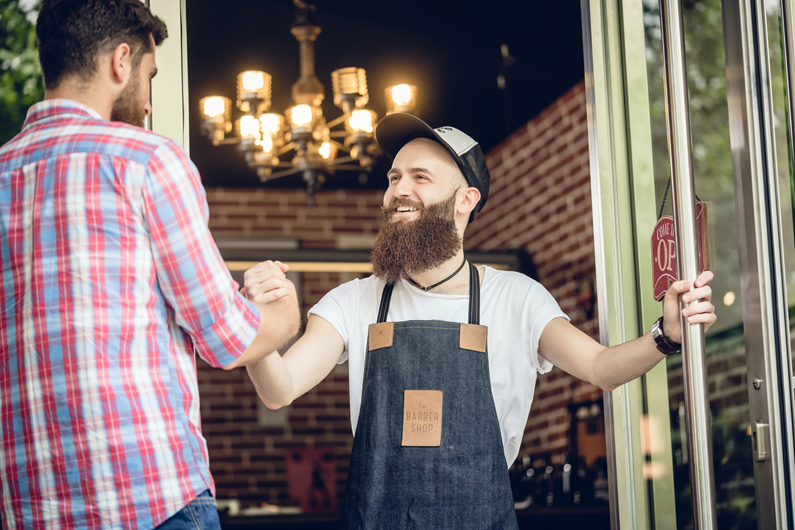
When I walk into my local Publix, someone usually smiles and says hello before I've even grabbed a cart. And it doesn't stop at the door. As I walk the aisles, the team members I pass often look up, smile, and greet me too.
Publix's tagline is "Where shopping is a pleasure." Those greetings are that line in action. Somebody decided how customers should feel, wrote it down, and built a culture around it. You can feel it the moment the doors slide open.
Compare that with a counter-service restaurant I've visited, where someone calls out the same welcome line every time the door opens. Often they don't even look up. Technically, it's a greeting. It even sounds friendly. But it's mechanical, and you can tell.
The words aren't what make Publix different. The smile is. The eye contact is. So is the feeling that a real person noticed you walked in.
Then there's the other end of the spectrum.
Not long ago, I walked into a barbershop for a haircut and was greeted with one word.
"Next!"
Someone shouted it from across the shop the moment I came through the door. Sitting in the chair, I heard it again and again as other customers walked in. I smiled, because it's so common in barbershops. But put yourself in the shoes of someone walking in for the first time. You open the door, and somebody yells at you.
"Next!" has a hidden cost, too. When several people are waiting, it leaves the customers to figure out who's next.
That's your job, not theirs.
(I wrote the full barbershop story, including what happened when I talked with the shop's owner, for barbershop owners on the EnRoute blog.)
Two kinds of businesses
Every service business ends up being one of two kinds, whether it means to or not.
In a transactional business, someone walks through the door and becomes the next body in line. Sit down. Get served. Pay. Leave. It's an efficient assembly line of service, but customers aren't products. They're people.
In a relational business, that same person is welcomed. Someone acknowledges them (often by name), lets them know what to expect, and treats them like they're glad they came.
Same counter. Same price. Same product. A completely different experience.
And being relational doesn't cost more. It doesn't take more staff, more square footage, or a bigger budget. It takes a few extra seconds and a decision about who you want to be.
There's a line often attributed to Maya Angelou that people will forget what you said and what you did, but they'll never forget how you made them feel. Customers who feel welcome come back, and when they come back, they bring friends.
Convenience gets them in. The relationship brings them back.
A couple of years ago, I wrote about customers who follow the path of least resistance. People often choose a business the first time because it's convenient. Whether they come back depends on what happens after they walk in.
In that post, I also said that whatever makes you convenient has to actually work. I was thinking about technology at the time, since a glitchy app can sabotage the whole experience. But the same is true of people. The best check-in system in the world does nothing sitting in a drawer, and a welcome line recited without looking up is the human version of a glitchy app.
"But that's the way we've always done it"
In my Idiocracy post, I joked about people irrigating crops with a sports drink because "it's got electrolytes." It's the same energy as "that's the way we've always done it."
Yelling "Next!" is the way a lot of shops have always done it. Reciting a greeting without looking up is the way a lot of counters have always done it. That doesn't make either one right. It just makes it the default, and defaults are exactly what culture is meant to replace.
As the young owner of that barbershop told me, "Change is scary sometimes." He's right. But staying with the default is a choice too. And by the end of our conversation, he was joking that he'd tell his barbers to stop using that word. "I know how to do it right this time," he said.
Culture is how the choice sticks
For more than 35 years, customer service has been the focal point of every business I've built, and it has treated me well. But for much of that time, my expectations lived mostly in my head. In my younger days, I didn't even know what culture meant.
I hired that way too. Friends, people I knew, people I had a good gut feeling about. More than once, it came back to bite me. The trouble wasn't necessarily who I hired. It was assuming that knowing someone meant we'd share the same expectations for how customers should be treated.
In 2020, we finally sat down at SoftwareKey and wrote it all out. Our mission, our guiding principles, our core values. It was a game changer. I've written before about how defining our North Star changed the way we hire.
One of our guiding principles reads, "We're not about the quick fix, but strive to find the fix quickly while keeping your long-term needs in mind." Once words like that are written down, a lot gets easier. Our culture goes out with every job description, so candidates know who we are before they apply. When someone falls short, I don't have to make it personal; I describe the behavior I saw and point to the standard we all agreed on. And because our values are on our website, customers can see them too, and hold us to them.
That's what I feel when I walk into Publix. "Where shopping is a pleasure" isn't just a slogan. It's a standard that people live up to, one hello at a time.
It's never too late to choose
I didn't write down my company's culture until decades after I started it, and it still changed everything. You don't have to start over to change the experience your business delivers.
We all have choices. We can choose to eat healthier, or to exercise. We can choose to smile and say hello when someone walks in. A lot of those choices are free, and a smile costs nothing. There are principles that make you a better service provider, and you have to decide whether you're up for making the better choice.
With the new year approaching, it's a great time to ask yourself a few questions. What do I want customers to feel when they walk through my door? How do I want my team to treat them? What kind of business do I want to be known for?
Write the answers down. Put them where your team and your customers can see them. Then hire for them, coach to them, and live by them.
You can't build a relationship with every customer in a single visit, but you can make every customer feel welcome. That's a pretty good place to start.
Transactional or relational? Which do you want to be known for?